
Metro is undergoing a profusion of new transit projects in 2026 with two transformative rail projects at the opposite ends of the San Fernando Valley, and the first segment of the D line’s West Side expansion set for opening on May 8, 2026. Transit projects south of the 10 haven’t received as much media attention even though the South Bay is home to one of the world’s busiest airports, a colossal industrial and logistics hub, several large firms in aerospace, and the Metro board recently greenlit the Hawthorne Plan for expansion of the K line.
Subsequently, these major projects require intense amounts of community input from the people who live, work, study, and frequently visit the areas in question. In addition to the Metro board itself, regional Metro Service Councils gather location-specific input and make decisions regarding transit developments in the area.
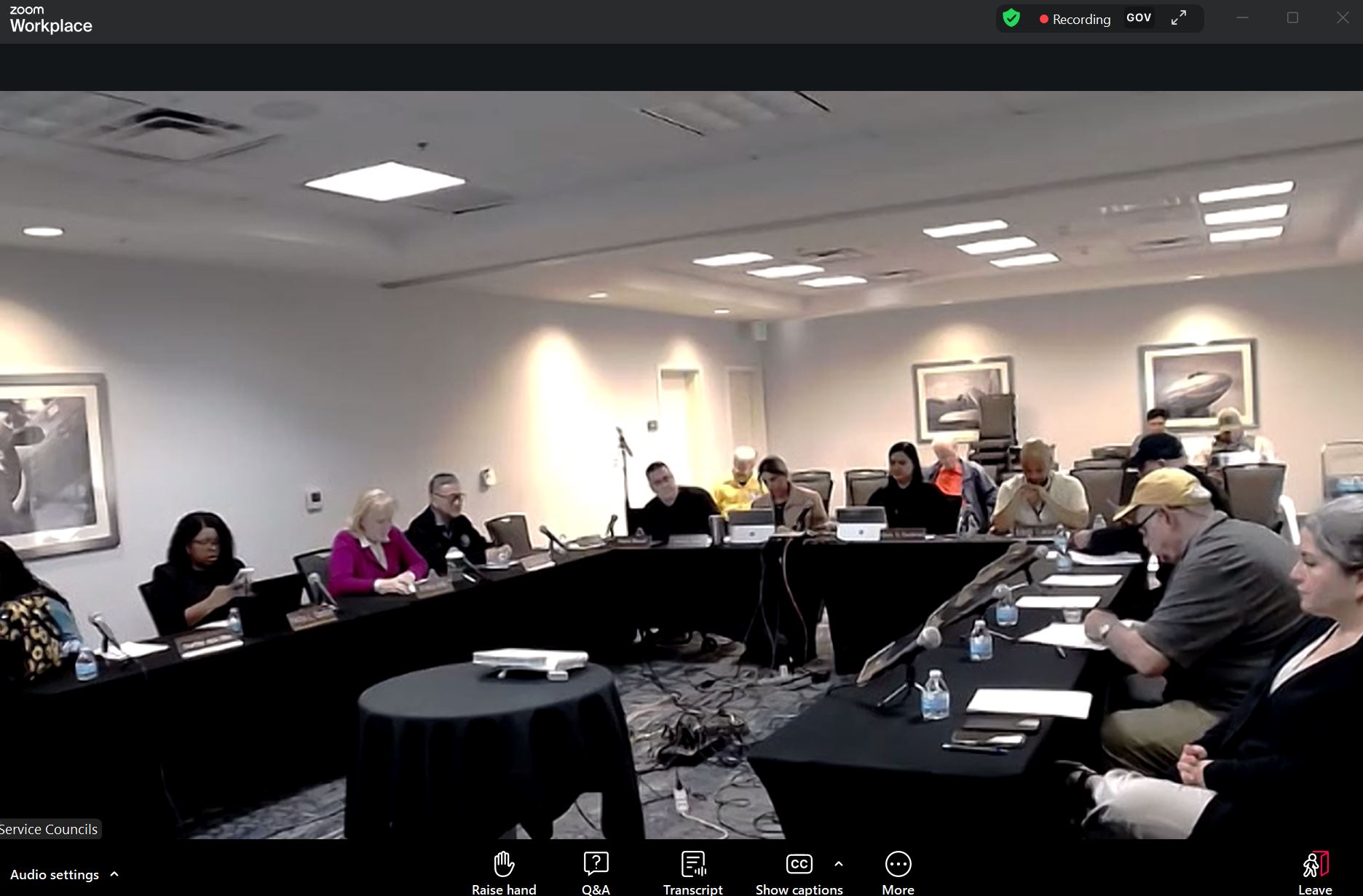
The South Bay Service Council’s boundaries span LAX and El Segundo to the west and Watts to the east, then the South Bay cities like Redondo Beach, Torrance, Gardena, Palos Verdes Estates, and San Pedro. The Council meets at the Residence Inn near the Redondo Beach K line stop typically on the first Monday of each month. Their March 2026 meeting focused more on freeways than transit, and governance than area-specific developments, but sheds some light on what future freeway updates could look like in the greater Los Angeles area.
What is a Metro Service Council?
Metro Service Councils are community councils dedicated to specific regions encompassing the vastness of Los Angeles County. There are five Service Councils: San Fernando Valley, San Gabriel Valley, Gateway, South Bay, and Westside Central which spans DTLA through Malibu and unincorporated areas of the Santa Monica Mountains. Metro Service Council members are appointed by the Metro board, regional Councils of Government, and in some cases, County Supervisors or mayors.
Similarly to the main Metro board, Metro Service Councils usually meet once a month and the general public is allowed to attend meetings in person or remotely to comment on issues. You can view Metro’s Service Council Areas map to learn more about how these councils operate and how to participate in your next Service Council meeting to give input on transit projects.
105 ExpressLanes Project Expects Completion By 2029
Surprisingly, the key transportation project discussed at the South Bay Service Council meeting wasn’t the Hawthorne Plan for the K line extension, or the LAX people-mover project that has been delayed numerous times. Rather, the primary project of the Service Council’s meeting was the 105 ExpressLanes Project which was put under Metro’s jurisdiction.
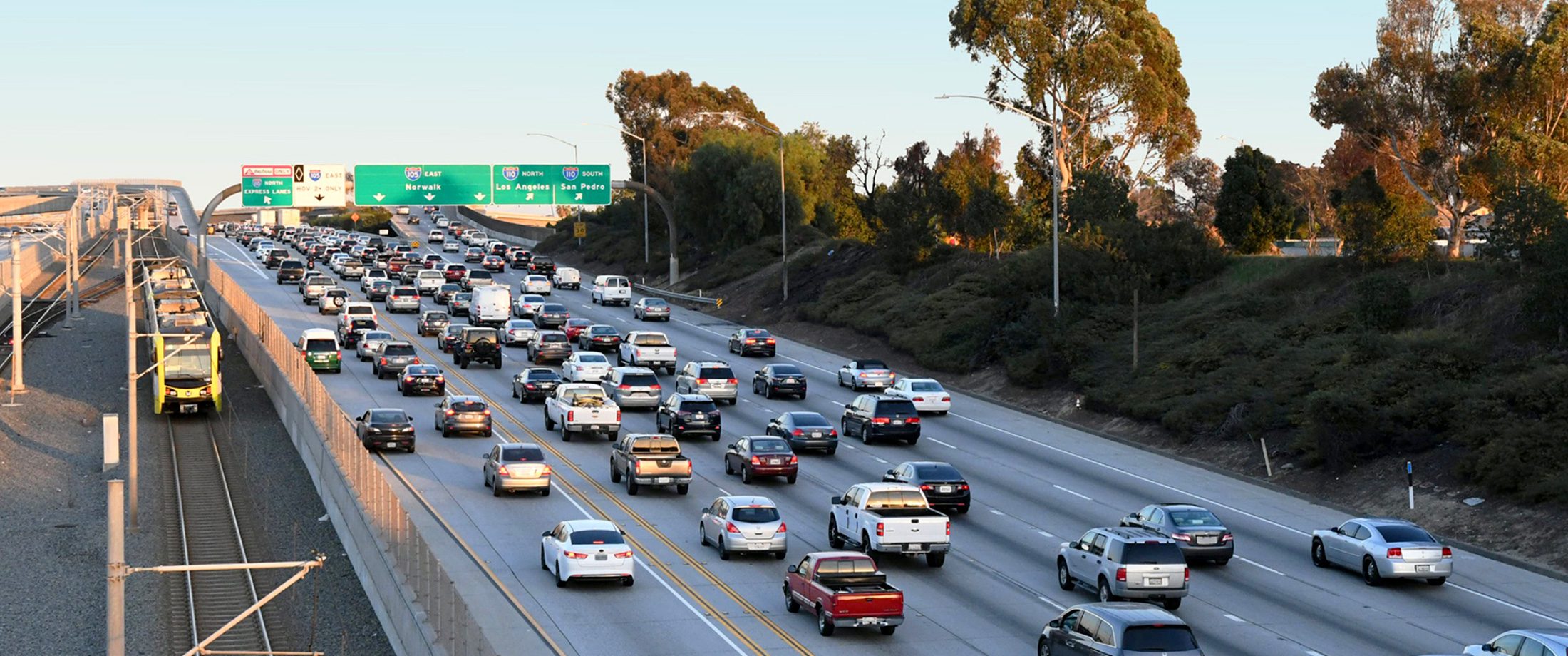
Why is a freeway project under Metro jurisdiction? This is likely due to the 105 freeway sharing nearly all of its alignment with the Metro C line that originates at the LAX Transit Center and terminates in Norwalk. The Metro board unanimously approved the funding for the 105 ExpressLanes project at the January 2026 meeting, with additional funds provided by voter-approved Measure M, a local sales tax earmarked for transportation infrastructure improvements and public transit development.
In addition to the shared alignment with the C line, buses of all kinds can use the ExpressLanes free of charge, whether they are Metro buses or private bus lines. At the South Bay Service Council meeting, a Metro representative elaborated that some of the funding allocated to the 105 ExpressLanes projects included additional funds to improve certain C line stations, namely the Harbor and Avalon stations. New lighting and wayfinding are forthcoming for these stations along with necessary infrastructure repairs and sidewalk restoration. It has also been said that future net toll revenue from the ExpressLanes will be reinvested into local transit and roadway projects located along the project alignment.
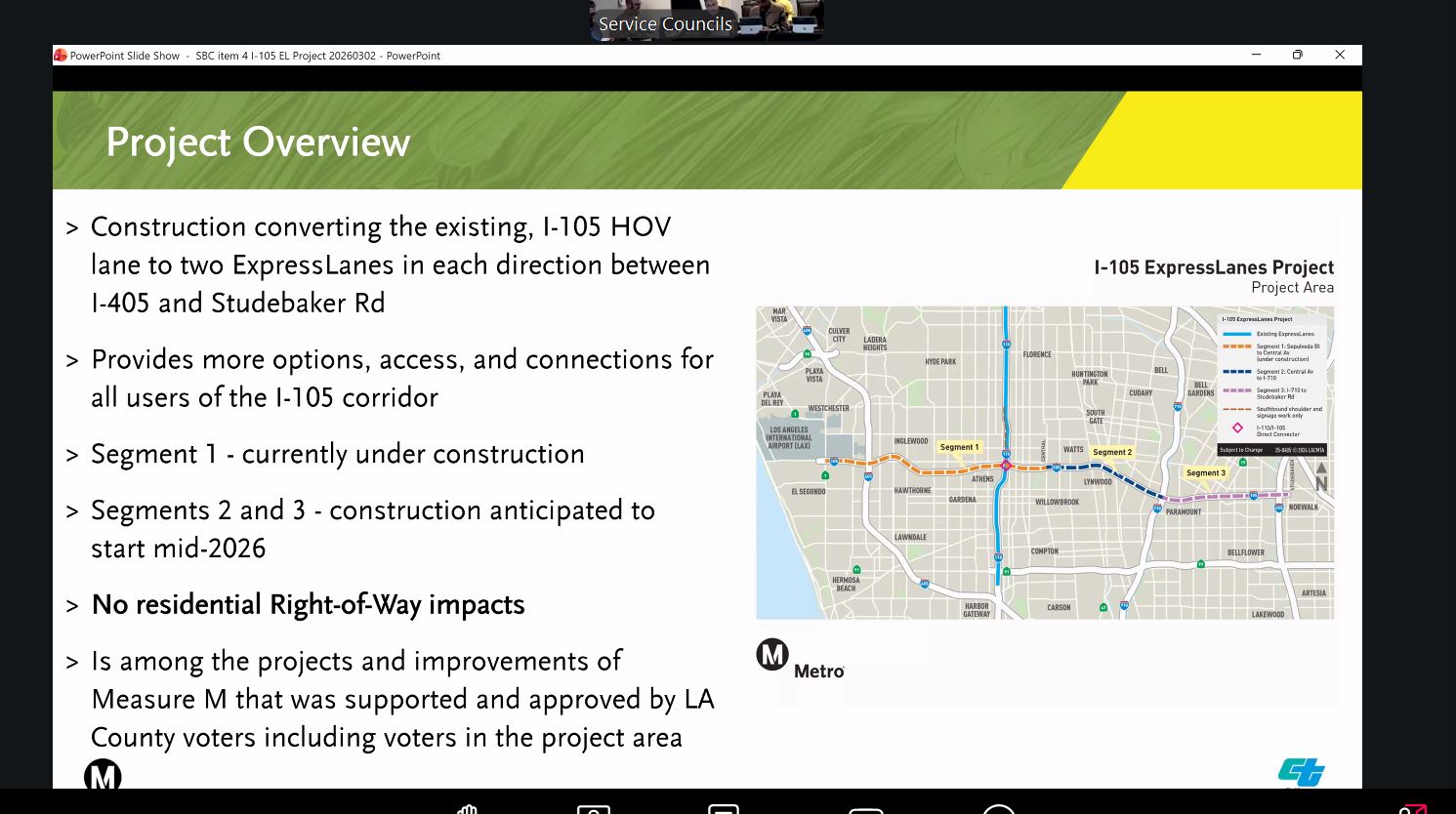
The representative also proclaimed that construction on Segment 1, the western part of the 105 connecting LAX to Athens, is slightly over 50% complete. Metro anticipates that construction on Segments 2 and 3 will commence by fall 2026 and Segment 1 will be complete in 2028. Segments 2 and 3 connecting Watts and Lynwood to Norwalk are expected to be complete in 2029.
The goal of the new ExpressLanes is to benefit all motorists and residents in South Bay, not just drivers using the ExpressLanes. New auxiliary lanes between I-710 and Long Beach Boulevard are being built to improve lane merging and facilitate traffic flow to reduce stop-and-go traffic and rear-end collisions. Other safety measures include enhancing nighttime visibility with new lane striping and channelizers (thin cones separating the lanes) for buffer zones between the ExpressLanes and general purpose lanes to reduce illegal merging.
There will be a seismic retrofit of the Alameda Viaduct and repair and construction of higher soundwalls along the 105, as South Bay residents and C line riders have expressed distress with the noise levels. A caller claimed that the noise was “deafening” where even noise-cancelling headphones cannot shut out the intense volume of the 105 when he waits for the train at Avalon station, and higher soundwalls are a must.
There are also no residential right-of-way impacts with displacement concerns, as the case has been historically with freeway development in Los Angeles and recently with residential and commercial disruptions for rail projects.
However, one of the more controversial aspects of the 105 ExpressLanes project is that drivers who choose to use them and do not have high-occupancy exemption, may be subject to dynamic tolls. When questioned on this by the South Bay Service Council, the Metro representative stated that the dynamic pricing is based on the level of demand and current congestion and may be as low as $0.10 per mile or as high as $2.80 per mile.
Council member Bob Wolfe expressed dismay that the 105 ExpressLanes was the key project discussed at this month’s meeting. “This is not a transit project, it’s a freeway project. The fact that this is under Metro’s umbrella is incredibly distressing.” Another Council member countered that freeway projects were not necessarily antithetical to transit development, as the 110 gave rise to the J busway and the 105 may do the same using after the ExpressLanes are complete.
After the Metro representative completed his presentation of the 105 ExpressLanes updates and timelines, the Council discussed their meeting calendar for the year that will face disruptions due to the FIFA World Cup at SoFi Stadium. The Metro Board and and all committees will go dark in June 2026 as they are required to work on game days. Governance changes were also extensively discussed, along with general Metro updates that LA Digs is keeping you updated on, such as the D line extension opening and the transformational Sepulveda Corridor project greenlit in January 2026.