
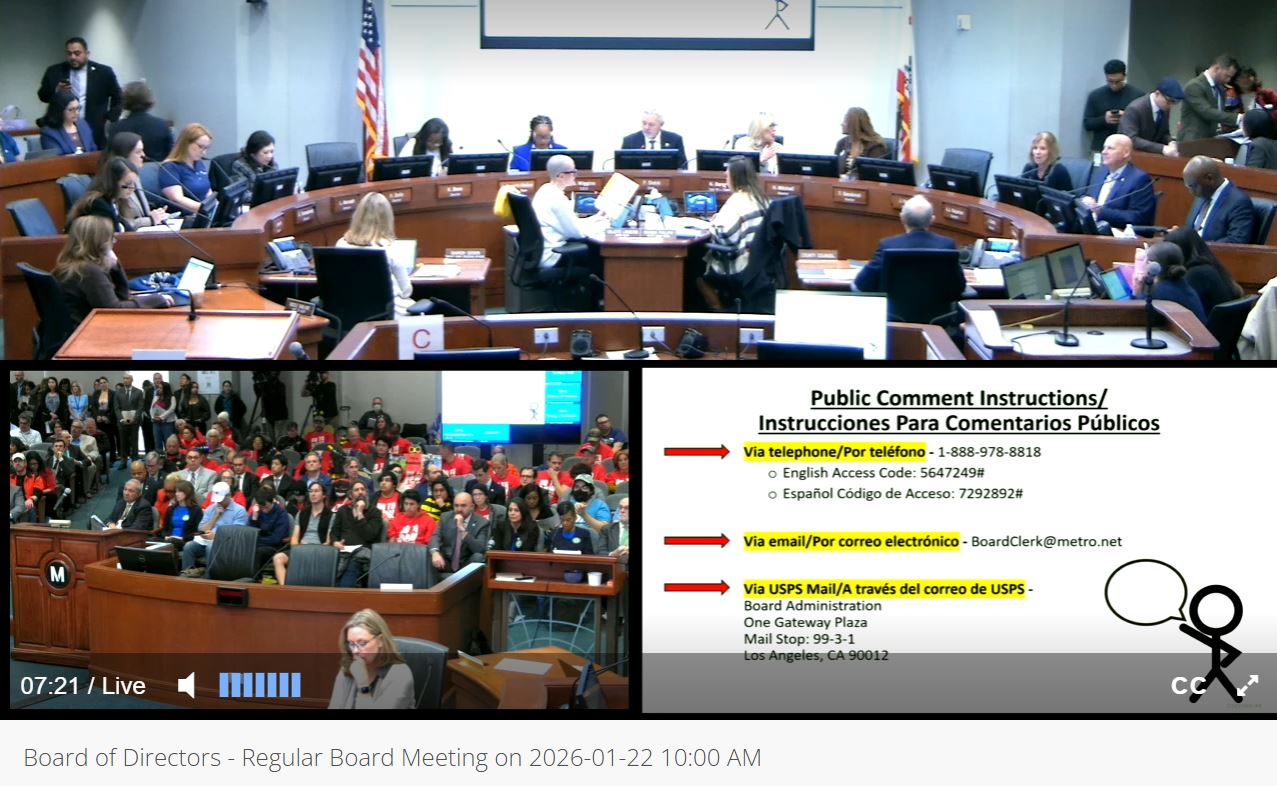
On January 22, 2026, Metro held their monthly regular board meeting at One Gateway Plaza near Union Station, where the public can attend and comment both in person and online.
The January 2026 meeting featured a prolific agenda with several transit projects, most notably the Sepulveda Transit Corridor that brought an extremely positive and excited mood to the first half of the meeting that lasted nearly a full workday.
The board also voted on several other motions, including the Metro C and K line extension to Torrance, and formal opposition of SB 79 to prioritize higher-density housing near transit stations.
Modified Alternative 5 Heavy Railway Unanimously Wins Metro Board Support

Several different options for the long-awaited Sepulveda Transit Corridor have been proposed over the years. They included monorail and heavy rail infrastructure, with heavy rail being the preferable option out of concern for grading, durability, and avoiding displacement of existing homes. The goal of the Sepulveda Transit Corridor is to decrease the massive strain on the 405, and reduce Angelinos’ reliance on cars going between the San Fernando Valley and the West Side.
The finished project will link the Van Nuys Metrolink station to the Expo-Sepulveda E line station, although the station list is not yet finalized.
Ever since six different rail options were presented to the public in summer of 2025, the Sepulveda Transit Corridor project received overwhelming support and more than 7,000 public comments expressing as such. After extensive cost-benefit analysis, Metro’s planning committee modified their original heavy rail plan and took elements of proposals 5 and 6 to bring Modified Alternative 5 to a final proposal. Metro staff projected that Modified Alternative 5 would result in higher ridership with the initial operating segment to focus on connecting the G busway to Sherman Oaks and Ventura Boulevard, prioritizing an area with comparatively less transit than the West Side.
At the meeting, several public comments were recorded with literally every single of them supporting Modified Alternative 5. Commenters included representatives from transit and housing advocacy organizations, business improvement districts in the Valley, community organizers, students, members and organizers of local labor unions, and everyday Angelinos who want more transit options in the San Fernando Valley.
Among the public comments in support of Modified Alternative 5, transit advocates mentioned fighting for a San Fernando Valley rail connection since 2012. A representative from the Sierra Club said he waited decades to see the proposal pass.
Educators and community organizers who gave comments emphasized the equity that the Sepulveda Transit Corridor will foster by helping students reliably get to school. Of the students who spoke in favor of Modified Alternative 5, many UCLA students, staff, and student advocates urged the board to include a dedicated station for UCLA to ease the immense congestion in the area.
Westwood community organizers pointed out that a dedicated station not only strengthens equity for low-income UCLA students in the Valley, but also eases the burden on the thousands of commuters who work in or near the school. Additionally, patients in the Valley who visit UCLA Medical Center will be able to see their healthcare providers without expensive rideshare or waiting for a loved one to take them to their appointments.
As the purple line extension gradually adds more stations, with a Westwood-UCLA stop south of the main campus slated to open in 2027, Valley residents will also have an expedited link to DTLA, Koreatown, and Mid-Wilshire: Modified Alternative 5 currently depicts a separate UCLA station close to UCLA Medical Center, with a connection at the incoming D line station on Wilshire Boulevard.
Santa Monica Community College (SMCC) students were also present at the meeting, voicing their support for Modified Alternative 5 and a dedicated UCLA station in addition to a dedicated SMCC station at Bundy and Sepulveda.
After hearing the numerous public comments, Metro board members gave their thoughts on the Sepulveda Transit Corridor. City Councilmember Katy Yaroslavsky said that this project will be just as formative to the region as the LA Aqueduct, although there are concerns in bringing costs down and consistently funding such a huge endeavor. Yaroslavsky emphasized that keeping alignment as minimally disruptive as possible remains a priority, which is why Valley residents overwhelmingly rejected the monorail proposals that would displace housing.
County Supervisor Lindsey Horvath noted that it’s remarkable the Sherman Oaks Homeowners Association now supports this project when HOAs historically have rejected rail alignment proposals.
Director Imelda Padilla remarked, “Transit success must bring people along, not push them away,” indicating that Metro must involve neighborhood councils, advocacy groups like Move LA, and the people who live, work, and attend school in the neighborhoods affected. Padilla commented that she’d never seen the Van Nuys Neighborhood Council as excited about a proposal as Modified Alternative 5 before, and believes it will be just as transformative to the Metro network as the 7th Street Metro hub in DTLA.
Mayor Karen Bass spoke to the uniquely robust economic power of the greater Los Angeles area, citing Measure M introduced in 2016 as a major driver for LA’s transit-forward future when cities and states are unsure whether they can rely on Washington D.C. to fund transit projects.
Director James Butts commented, “This project has gone through four CEOs, three mayors, and two Yaroslavskys. It has to pass!” With that, the motion for the Sepulveda Transit Corridor unanimously passed 13-0.
Metro Board Unanimously Chooses Hawthorne Option over ROW Hybrid Alternative
The next major item in the Metro board’s agenda for the January 2026 meeting was met with more division, despite residents’ and transit advocates’ excitement to see more transit in the South Bay.
Similarly to the Valley, the South Bay is a populous major job center that suffers from traffic congestion and lack of reliable transit. The nearest Metro rail station is in Redondo Beach, near the city of Lawndale. Torrance has no rail access at all, with the nearest Metro infrastructure being the J busway that operates between San Pedro and El Monte.
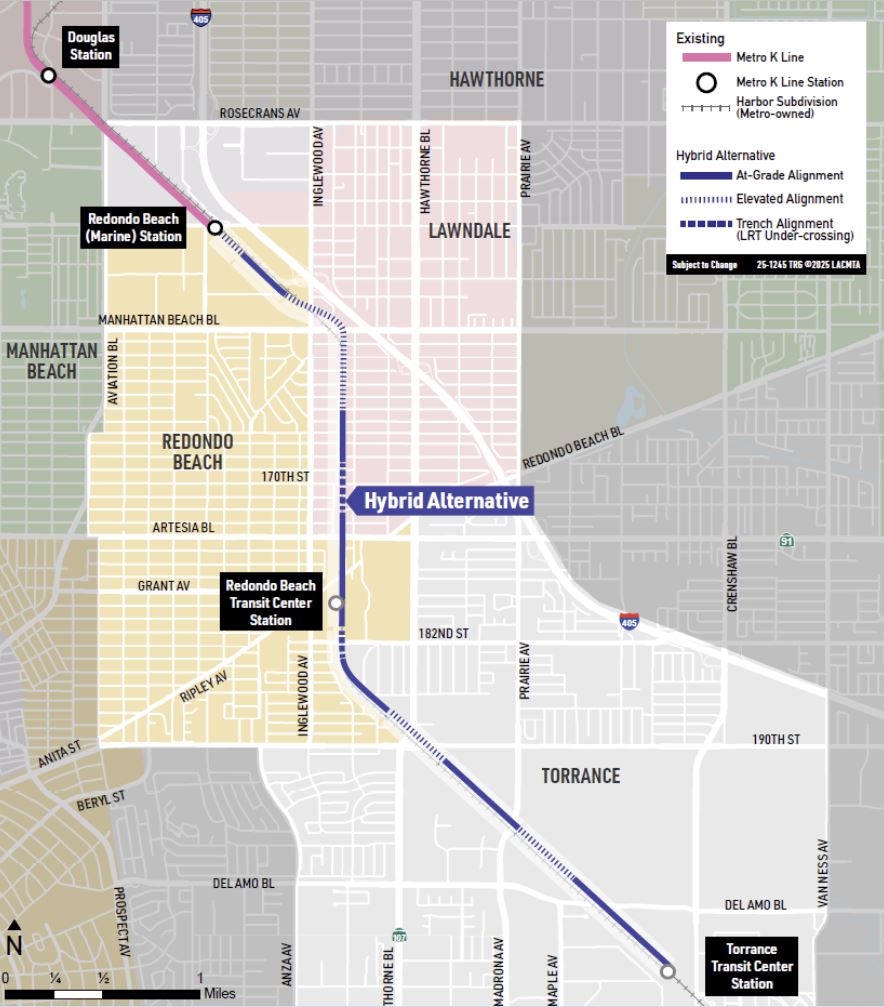
A few proposals to expand the C and/or K rail lines into Torrance with 4.5 miles of new rail were made over the years, with Metro engineers recommending the locally preferred alternative to use the right-of-way (ROW) Metro purchased in 1993 specially for developing rail. The ROW plan, later named the Hybrid Alternative based on a combination of different grading proposals, would’ve used the existing freight rail track along Firmona Avenue following the tracks south into Torrance. Upon completion, this would enable Torrance residents to reach LAX within 19 minutes without a car.
Between 2021-2025, over 4,700 comments were received in support of expanding the K line to Torrance no matter which proposal was used, including one to route the stations along Hawthorne Boulevard instead of the existing tracks plus new alignments. The Hybrid Alternative garnered more favor with Torrance residents because Metro would need to close lanes on Hawthorne Boulevard and cooperate with CalTrans, also requiring the eminent domain of 13 commercial properties. Not only would this cause economic damage with the loss of jobs and annual sales tax revenues, but also incur a significantly higher cost due to taking longer and lacking right of way. The Hybrid Alternative already secured 50% of its funding, with an expected completion date of 2036 for two new stations, the Redondo Beach Transit Center and expanding Torrance Transit Center from a bus hub into a rail station.
In comparison to the Hybrid Alternative, the Hawthorne option would approve the two new stations extending from the existing Redondo Beach station along Hawthorne Boulevard before rejoining the ROW south of 190th Street to the southern terminus at Torrance Transit Center. The Hawthorne plan was 40% funded via Measures M and R.
Two hours of public comment ensued prior to the board’s deliberation and vote, with mixed opinions on both proposals. While there were some detractors on both sides, Lawndale and Redondo Beach residents and city officials were largely in favor of the Hawthorne option while Torrance residents, business owners, and city officials adamantly opposed it.
A Torrance business owner commented that $28 million in sales tax revenue would be lost annually due to the Hawthorne option requiring the eminent domain of several commercial properties. Other Torrance residents and business owners voiced similar concerns about potential commercial and residential displacement. Torrance Mayor George Chen spoke in favor of the Hybrid Alternative, commenting that years of construction along Hawthorne Boulevard would be too disruptive to Torrance businesses and residents alike. Bridgett Lewis of Torrance City Council also spoke in favor of the Hybrid Alternative, voicing disapproval of the eminent domain plus 70,000 vehicles to be rerouted per day.
John Fox, Special Counsel for the City of Lawndale, voiced opposition for the Hybrid Alternative in favor of the Hawthorne proposal due to environmental concern and that the health and safety impacts have not been properly evaluated. Many Lawndale and Redondo Beach residents voiced similar concerns about noise, environmental hazards, and a fear of derailment and collisions, with Todd Kearney of Lawndale City Council stating his approval for the Hawthorne plan in line with his constituents.
The mounting support for the Hawthorne plan was met with dissent from housing advocates and concerned Torrance residents who felt that it was inequitable for low-income South Bay residents. A concerned resident proclaimed “Hawthorne Boulevard is the lifeblood of the region” and that businesses and residents cannot survive six years of construction along the arterial boulevard.
The board deliberated after public comment closed, with Director James Butts stating that he’d never seen so many people show up to speak on an issue after 53 years in public service. County Supervisor Janice Hahn voiced her support of the Hawthorne option “with apologies to Torrance” even though it would cost $750 million more than the Hybrid Alternative that Metro staff recommended. Director Ara Najarian was initially against the Hawthorne proposal, but flipped his position based on his colleagues’ support of the plan. Directors Holly Mitchell, Tim Sandoval, and Jacquelyn Dupont-Walker had voiced their adamant support of the Hawthorne plan before the floor opened.
The board then voted unanimously in favor of the Hawthorne option, overriding their original approval of the Hybrid Alternative.
Metro Approves Funding for A Line Extension, Formally Opposes SB 79 Implementation for Building Apartments Near Transit
With the two major transit expansion proposals decided on, the board moved to several other items.
The 105 expresslanes project was briefly discussed. This project will convert existing HOV lanes on the 105 into two Metro Expresslanes where lone drivers pay a toll to use them, but carpools and buses drive toll-free. The motion passed 11-0 with no public comment.
The A line, now the longest light rail line in the world after opening three new stations including a terminus in Pomona in 2025, will become even longer after $95 million in funding was approved to build the Claremont station. However, the funding does not include the Montclair station originally proposed for the final phase of the Foothill Extension Project, although transit advocates plan to revisit it in the future.
A slew of California state laws passed in 2025 include SB 79, a law that allows high-density apartments to be built in neighborhoods within 0.5 miles of major transit stops even if the neighborhood is currently only zoned for single-family homes.
Housing advocates celebrated the bill’s passage, especially since housing affordability and constrained availability remains a top concern for rent-burdened Californians. Metro initially opposed SB 79, and housing advocates and concerned citizens gave extensive public comment urging the board to reconsider their position: as the city slowly becomes more transit-oriented and approves one of the most transformative infrastructure projects in decades, embracing mixed-use development and dense housing in America’s second-largest city only makes sense. With dense housing situated within walking distance of transit stations, ridership also increases.
Despite public comment largely being in favor of implementing SB 79 at the local level, only two board members defected from the original decision to oppose local implementation of the law and so the opposition to SB 79 was upheld.